
FGC for Adults: summary of research findings

Report which provides a summary of the findings from research led by Professor Jerry Tew, University of Birmingham.


We are pleased to share this summary report. The full research is due to be published later in the year.

The findings help to build the picture of the positive impact that Family and Group Conferencing for Adults (FGC) can have for people, wider networks and systems.

Funded by the National Institute for Health and Care Research (NIHR), research into Family and Group Conferencing for Adults was undertaken between November 2022 and November 2025.  The research took place across three sites comprising two local authorities and one NHS Trust.

What Family and Group Conferencing for Adults supports

The research found that FGC for Adults can support: 
  • People to write their own plans for care or recovery built on strengths, capabilities and preferences​.
  • Improved wellbeing for people and network members​, representing improvements in people’s living situations, support to take up new opportunities or an enhanced sense of independence. For network members (such as unpaid carers) this reflected reduced stress and isolation from a more shared caring responsibility. 
  • Empowerment and recognition – people experience a greater sense of control and sense of being understood by others.
  • Relationship capital – a widening and deepening​ of networks of support which was often sustained well beyond the Conference.
  • Collaborative and coordinated systems – professionals across services sharing information and working better together.
  • Safety – wider family and networks supporting people to stay safe and free from abuse. 
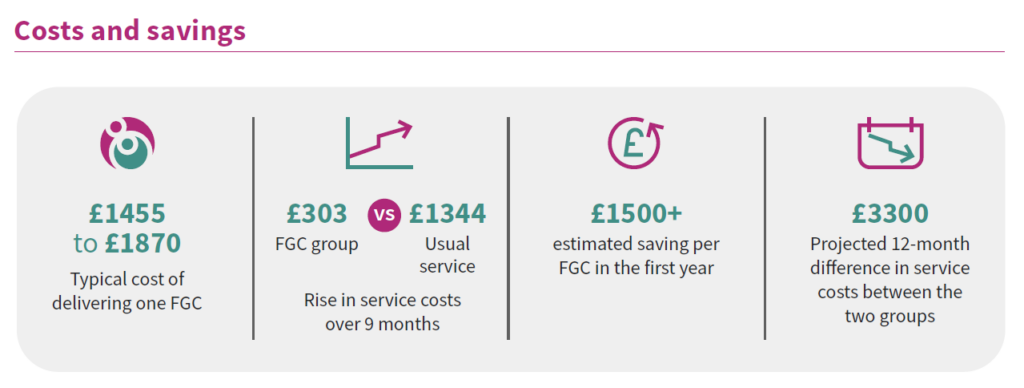
  • Better use of resources​ – with each FGC saving an estimated £1,500+ in the first year.
An infographic of the costs of FGC.

The clear three-stage structure of an FGC provides the scaffolding for people to take an active role in designing their own care and support and writing plans centred on their preferences, strengths and natural resources. The role of a skilled coordinator to facilitate the process is key.
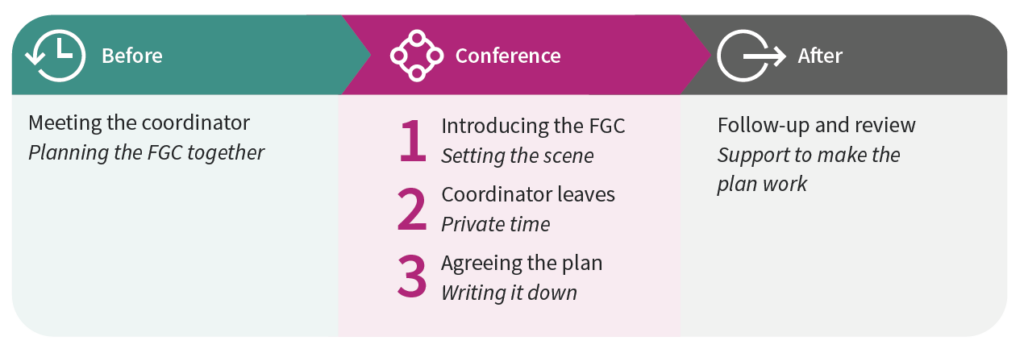
Infographic of the FGC model

A key finding from the research was that the preparation and relationship-building undertaken by the coordinator ahead of the Conference is crucial to its success. 

These findings demonstrate that the FGC approach can be a powerful way to support adults during a range of life stages, and make the case for an increased investment in the model.