
Over 2022-23, Rhondda Cynon Taf County Borough Council in Wales commissioned Community Catalysts to work with them to develop community micro-enterprises.
From January to July 2024 Rhondda Cynon Taf County Borough Council commissioned Practice Solutions to complete an an external evaluation of the project. This is a summary of the findings.
The project aimed to grow the local social care market, increasing choice and control for people who seek care or support. It also created opportunities for local entrepreneurs seeking flexible work in the community.
Micro-enterprise leaders reported significant levels of job satisfaction.
Having the flexibility to be led by the choices of the people they support was a significant factor in the person’s job satisfaction. Micro-enterprise leaders highlighted that they can do things which are simple, but wouldn’t be possible in a shorter visit, and/or without having an effective two-way relationship with the person – paying attention to what someone truly wants and needs on that day.
“You’re supposed to be responding to individual needs. Everybody’s different – you can’t have one rule for all.”
Micro-enterprise leader
Community micro-enterprises in Rhondda Cynon Taf are helping people to live independently, engage in their local communities, and experience care, which is dignified, relational and responsive to their needs.
People with experiences of traditional domiciliary care say they have had a significantly better experience from the care they’ve received via a community micro-enterprise.
“Oh my god, what a difference in how [the micro-enterprise, compared to the agency staff] enters the property, how she greets her, how she approaches her, her whole tone – she’s amazing, she’s worth her weight in gold.”
Family member
Community micro-enterprises can help prevent hospital admissions and people falling into crises. It was observed that enterprises are well placed to notice and act responsively and reflexively to the needs of the people they are supporting, and their families. One social worker recognised this, and talked about its preventative impact:
“The micro-enterprise] is absolutely phenomenal. She’s really proactive – we’ve managed to keep [the service user] out of hospital because of the support she’s had.”
Social worker

The Small Good Stuff directory of local care and support services was reported to help people choose a micro-enterprise. The combined efforts of the person being supported and the social worker in ‘choosing’ a micro-enterprise together was viewed as positive.
Assuming the growth of direct payment recipients remains at a level slightly above the current trend and the 30% of those using a micro-enterprise would otherwise use traditional domiciliary care, the savings shown below would be achieved.
The model was completed by Perago for Rhondda Cynon Taf County Borough Council.
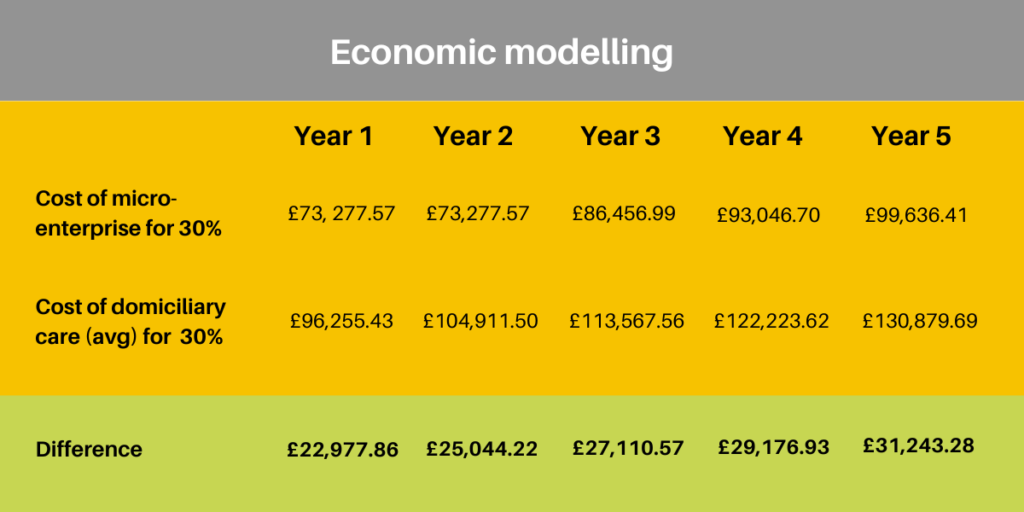
The invest to save proposal recommends that funding of £135,000 per annum is made available to continue the community micro-enterprise project in Rhondda Cynon Taf from April 2025.
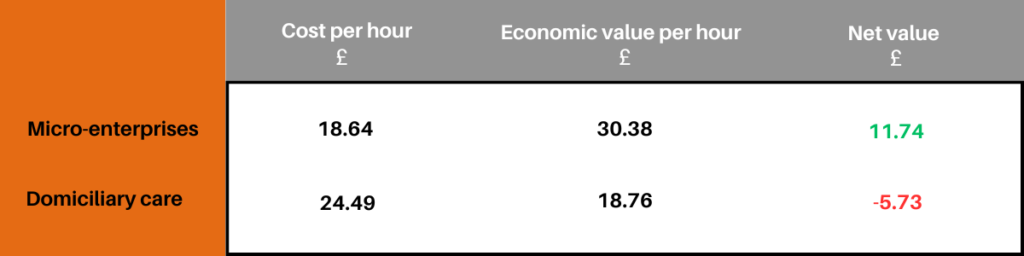
Welsh Government use the local multiplier of 1.63 from the Foundational Economy Strategy to showcase the economic impact of public money spent locally or in Wales.
By applying this principle to micro-enterprises produces the economic impact show below. This is compared to spend on traditional domiciliary care, where 80% of current contracted providers are based outside Wales.
“The support of Community Catalysts has been invaluable to micro-enterprises, both in terms of meeting the challenges of self-employment, and understanding the rules and regulations around micro-enterprises.
Community Catalysts have also played a pivotal role in stimulating interest and understanding among care teams across the Council, helping to build a cohort of early adopters who have engaged with Micro-enterprise as a care option for people needing support.”