
A groundbreaking study conducted by researchers at Swansea University, with Local Area Coordinators at Swansea Council and people they are alongside, shows why strong relationships are essential in Local Area Coordination.
Local Area Coordinators spend time developing rapport, trust, and connection with citizens. They help people to identify their version of ‘A Good Life’ and encourage them to utilise their personal strengths, connections, and contributions to achieve their goals.
Therefore, supporting people to integrate and build positive relationships within their community is one important aspect of the Local Area Coordinators’ role. This new research aimed to investigate the role of relationship rapport, community integration, and wellbeing in Local Area Coordination’s approach.
There were three different types of data we collected in the study to give a fuller picture: heart rate variability, survey results and focus group discussions.
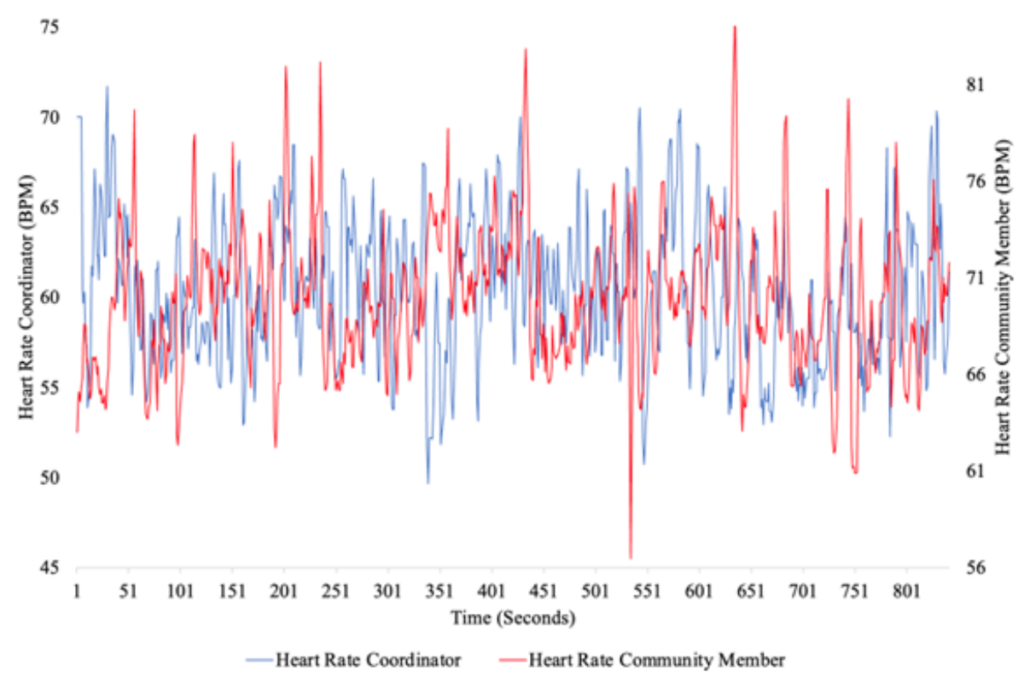
This involved fitting citizens and the Local Area Coordinators who walk alongside them with heart rate devices to collect data during their typical conversations. The data suggested that the pairs in the study, on average, were synchronised in both heart rate and heart rate variability (HRV) during conversations (when one person’s HRV increases or decreases, the other does simultaneously).
But what does all this mean, and why is it important?
Heart Rate Variability is linked to how well the vagus nerve (a nerve which connects the brain to nearly every organ in the body) is functioning. Previous studies have shown that the vagus nerve provides the physiological groundwork of wellbeing and supports our ability to connect to our self, others and nature. When we experience anxiety, fear or anger, our body’s threat response is activated (increased heart rate, tummy butterflies, shallow breathing, racing thoughts). This response (sometimes called the fight or flight response) closes us off from social connection as our attention turns inwards and our body prepares us to manage the ‘threat’. On the other hand, when we see our environment as safe and secure, this calms us and overrides stress hormones.
This kind of research is still very new, but evidence suggests there might be a physiologically ‘calming’ effect to the Local Area Coordinator-citizen relationship. Early evidence also suggests the presence of a known, trusted, and compassionate Local Area Coordinator may facilitate a sense of safety on a physiological level, thus reducing anxiety and increasing confidence and capacity for future interactions.
A survey was sent out to citizens who were walking alongside Local Area Coordinators across the (England and Wales) Local Area Coordination Network. A total of 52 surveys were completed. Whilst there are many factors determining wellbeing (see results of study 3), this survey focused specifically on the impact of Local Area Coordinator-rapport and community integration on psychological wellbeing.
The survey revealed the following findings:
Positive relationships between Local Area Coordinators and community members indirectly impacted wellbeing. By design, Local Area Coordinators support people to build connections within the community to promote wellbeing which reduces the risk of building dependence on a Local Area Coordinator for social interaction.

The focus group included 12 citizens and Local Area Coordinators in Swansea, who discussed their experiences of Local Area Coordination. The feedback from the group can be summarised through the following six key themes.
Local communities hold an abundance of opportunities to promote positive health and wellbeing through factors such as social capital, emotionally supportive relationships, positive emotions, meaning, autonomy, increased physical activity or time spent in nature. However, integration can be challenging, particularly when communities experience marginalisation.
This study highlights the importance of natural relationship bonding: building consistent, trusted relationships which foster a feeling of safety. It suggests that rapport is a crucial first step necessary to support people to join new social groups or positively change their behaviour. It highlights the need for longer, in depth conversations and taking a truly personalised approach while alongside people. Local Area Coordinators’ true embodiment of compassionate relationship building appears to be key in successfully supporting individuals to integrate into their communities, and ultimately improving their wellbeing.
Health and social care systems must urgently adapt to a changing population, as the number of people living with chronic conditions, mental health disorders and multi-morbidities is rising globally, alongside worsening health inequalities in the UK. Health and social care models designed to support individuals only at the point of crisis or illness can only respond by unsustainably further increasing demand. To overcome these challenges, there is an urgent need to support people to live happier and healthier lives in their own communities. Overall, Local Area Coordination’s person-centred, community-led approach is an opportunity to unleash community assets, empower individuals, and improve health equality by building wellbeing in people who often have the least opportunity to do so.
“My Local Area Coordinator…always wanted to help me, and he was always there for me. And that was what I felt was fundamentally important. I wasn’t a number; I wasn’t a figure”.
“She [my Local Area Coordinator] is persistent. But I mean that’s brilliant, because to me that’s the best thing about her, that she does care.”
“I gained the confidence to just get out there and meet people.”
“I got so much nice company. I can phone them if I am low”. “It’s just wonderful to me. You know, it’s made a big difference, I got so many friends now… I’m not lonely anymore.”
“I got the support I needed not through one of the formal ways”.
Quotes from citizen participants from the study focus group conducted in June 2022.
The pre-print of this study is available here.
Written by: Lowri Wilkie (Psychology PhD Candidate, Swansea University)
Edited by: Tom Richards and Cat Thomas